
Egg-carton claims: organic, baladi and omega-3 — what does the producer actually owe you?
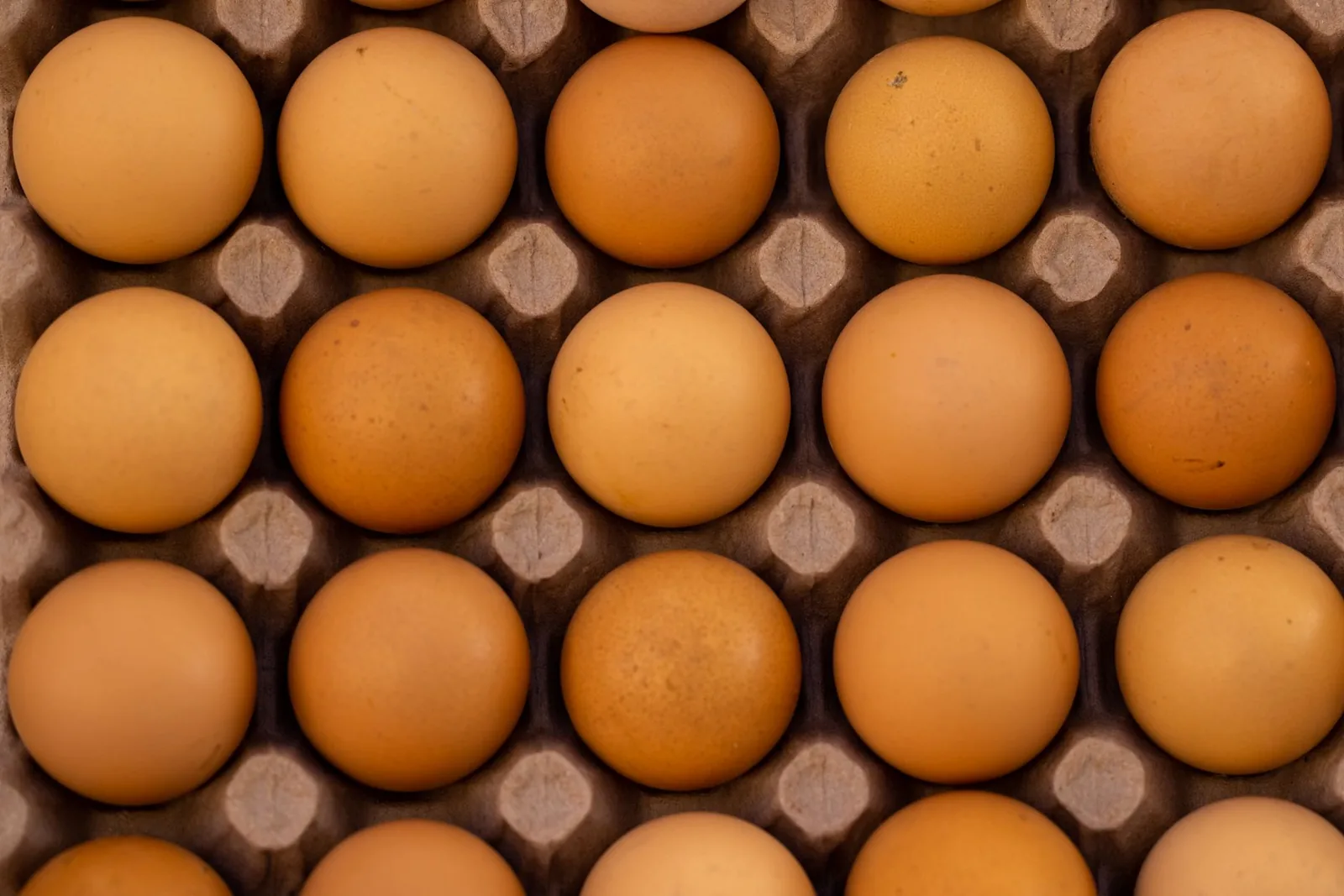
Eggs are among the most frequently repurchased items in a Saudi household, and at the same time one of the products whose packs compete on words rather than on contents. The gap between two cartons on the shelf can be double the price, while the visible difference between the two eggs once cracked into a pan is close to nil. So the practical question is not which egg is better, but a sharper one: which word on this carton obliges the person who wrote it to something verifiable, and which is free marketing copy. This lesson answers that word by word — including the one case where a genuine laboratory difference does exist, and where it turns out not to be the difference most buyers imagine.
Rule one: some claims have an authority behind them, and some have none#
Before any detail, sort the words on the carton into two columns. Column one: terms that are defined in regulation — a text that specifies them, a body that grants them, a register you can look them up in, and a penalty for anyone who writes them without the right. Column two: terms with no regulatory definition in the egg market, which mean whatever the producer intends and oblige him to nothing more. That single split removes most of the confusion at the shelf, because it moves the question from which word sounds better to which word can be checked.
- Backed by a regulation and a body: “organic” and its derivatives, which fall under the Kingdom's Organic Agriculture Law and its executive regulation.
- Subject to regulatory conditions: nutrition claims such as “omega-3 enriched” or “source of protein”, which fall under the Gulf technical regulation on health and nutrition claims applied by the Saudi Food and Drug Authority.
- No regulatory definition in the egg market: “baladi”, “natural”, “straight from the farm”, “premium”, “extra” when used as marketing copy rather than as a weight grade.
- True but misleading: “hormone-free”, a statement that is accurate about all commercially produced eggs, not about this carton in particular.
“Organic”: the one claim with a logo and a register behind it#
Organic farming in the Kingdom is not a free-form description. The Organic Agriculture Law was approved by Council of Ministers decision no. 395 of 5/9/1435 AH and issued under Royal Decree no. M/55 of 16/9/1435 AH, with an executive regulation issued by the Ministry of Environment, Water and Agriculture setting out production and certification requirements. Certification itself is not granted farm by farm by the Ministry: it accredits inspection and certification companies that operate under its supervision and carry out periodic inspection visits to production units, and on the strength of their certificate a producer earns the right to place the Saudi national organic logo on the pack.
That gives you something rare in the world of food packaging: an actual verification step you can perform yourself. The Ministry tells consumers plainly to check for the logo when buying an organic product, and the logo is not decoration — it is a statement that the product was supervised from cultivation to the point of sale. If a pack prints the word “organic” in large type but carries no logo, you are looking at a word with nothing behind it, and you are entitled not to pay for it.
- Look for the Saudi national organic logo on the pack itself, not for the word alone.
- Read the certifier's name and certificate number if they are printed; their presence signals a producer who knows he will be audited.
- Look the producer up through the online enquiry service for registered organic production units — the fastest way to expose a carton that has borrowed the word.
- For imports, remember that what is required is an organic certificate from a certifying body in the country of origin plus compliance with Saudi labelling data — not merely a foreign-language phrase on the wrapper.
The logo matters more than the word. If the whole lesson had to shrink to one behaviour at the shelf, make it this: do not pay the organic premium for a carton that does not carry the national logo, however many times the word appears on its four faces.
Is organic egg more nutritious?#
Two questions get mixed here and need separating. An organic egg tells you something real about the production method: feed grown without pesticides, fungicides, herbicides or commercial fertilisers, and a husbandry system subject to inspection. What it is not is a promise of a different nutritional composition. University poultry extension guidance puts the point plainly: organic eggs are eggs from hens fed rations grown that way, and the nutrient content of the eggs is not affected by whether or not the ration is organic.
Getting that sentence straight saves you an entire argument. Someone who buys organic to support a particular production system, or to avoid pesticide residues in the feed chain, is buying something that genuinely exists. Someone who buys it expecting more protein or more vitamins in the egg is paying for something nobody promised. The same applies to backyard and smallholder eggs: eggs from backyard hens and fertilised eggs do not contain less cholesterol than eggs bought at the shop — one of the most widespread and least supported beliefs about eggs.
“Baladi”, “natural”, “from the farm”: market descriptions, not regulatory categories#
“Baladi” in the Saudi market carries several meanings depending on who says it: it may mean a breed other than the commercial white-egg lines, or a less intensive husbandry system, or simply that the eggs were collected from small nearby farms. The problem is not that any of those meanings is wrong; it is that no text obliges a seller to one of them rather than another, so the word alone cannot tell you which you are holding. The same goes for “natural”, “straight from the farm” and “premium”: words that describe an impression, not a standard.
The only category on an egg carton that means something measured and unambiguous is the weight grade, because it is fixed by a number rather than an opinion. Which is why reading a carton should start at the bottom, not the top: at the weight line, the date and the producer details, not at the marketing banner above them.
“Omega-3 enriched”: a real difference, but not the expected one#
This is the only claim on the list with a confirmed laboratory change behind it. If omega-3 sources are added to a laying hen's ration, part of them really does move into the yolk. Three sources are used in practice: flaxseed and its oil, rich in alpha-linolenic acid; fish oils, rich in EPA and DHA but liable to leave the egg with a fishy taint; and microalgae, an excellent source whose high production cost limits its use.
The size of the difference is where the confusion lives. In figures from Bean and Leeson (2003), widely cited in the poultry-production literature, a ration containing 10% flaxseed raised yolk DHA from 53.3 to 83.7 mg in a 50-gram egg, while alpha-linolenic acid in the same egg rose from 38.5 to 306.3 mg. In other words the large jump was in plant-source omega-3, not in the long-chain marine type. In an earlier comparison by Aymond and Van Elswyk (1995), a ration with 1.5% menhaden oil and one with 15% ground flaxseed deposited DHA at 83 and 90 mg per egg respectively.
Why does the distinction matter? Because the body converts plant-source alpha-linolenic acid into the long-chain marine acids only with limited efficiency. Human-nutrition reviews put conversion to EPA at a small single-digit percentage, and conversion to DHA far lower and sometimes barely measurable, with higher efficiency in women. So a carton advertising omega-3 is telling the truth that its hens' ration was modified — but what was added in quantity is the form your body converts with difficulty.
Turn the carton over. A nutrition claim is measured by a number, so look for the omega-3 content in milligrams per egg, and for its breakdown if given. A pack that announces the claim on the front and states no figure on the back gives you nothing to compare with — reason enough on its own to prefer one that does.
What a producer takes on when he prints a nutrition claim#
Nutrition statements are not free text written by a marketing department. Labelling of prepackaged foods in the Kingdom follows the Gulf technical regulations adopted by the Saudi Food and Drug Authority — among them the regulation on labelling of prepackaged foods (GSO 9), the regulation on requirements for foods carrying health and nutrition claims (GSO 2333, adopted by the Authority as SFDA.FD 2333), and the regulation on nutrition data requirements on the label. What their existence means in practice is that a nutrition claim is conditional: it may only be printed if the product meets the stated conditions, and the number supporting it becomes part of the obligation rather than an optional detail.
- A nutrition claim is a regulated statement with conditions attached, not an impressionistic description like “healthy” or “good for the heart”.
- An explicit figure on the label supporting the claim is the first sign of a producer complying with the regulation.
- The absence of any nutrition data behind a claim announced on the front is good reason for doubt, not a detail to wave away.
- Health claims linking a product to a disease or a specific bodily function are subject to prior evaluation, and are not phrases anyone may write at will.
“Hormone-free”: a true sentence put to misleading use#
This one deserves a pause because it works differently from the rest: it is not a lie, but it markets a general truth as a specific advantage. Commercial poultry in modern production systems is not given growth hormones; the speed of growth comes from decades of genetic selection and from improved feed and husbandry. So when a carton says it is hormone-free, it is saying something true about itself and about its neighbour on the shelf at the same time, while leaving the impression that the neighbour is otherwise. The working rule is simple: a claim that applies to every product in the category does not distinguish between them, and is no basis for paying a premium.
The shelf minute: ordering the decision#
The difference between an informed buyer and an uninformed one is not information but sequence: what you look at first. The list below orders the minute you spend at the shelf from most to least important.
- Check the shell first: a cracked or soiled egg cancels everything written on the box.
- Read the date and the storage condition printed with it; those two decide what you actually get in your kitchen.
- If you are paying an organic premium, look for the national logo and the certifier's name before you pay it.
- If the claim is “omega-3 enriched”, turn the carton over and look for milligrams per egg.
- Ignore words with no number, no logo and no authority behind them: “natural”, “premium”, “hormone-free”.
- Compare price after that, not before, so that the comparison is between two genuinely comparable things.
And the conclusion worth keeping after the details fade: an egg is not improved by the words printed around it, but by how it was produced, kept and moved. A useful word is one that refers you to an authority or to a figure; the rest is advertising you pay for twice — once at the till, and again when you expect from the egg something it was never going to give.
Frequently asked questions
Is organic egg safer than ordinary egg?
Organic certification concerns the production method, the feed, the husbandry system and the inspection regime — not whether the egg carries microbes. Any egg, organic or not, is handled as potentially carrying salmonella until properly cooked, and is subject to the same chilling and storage rules. Organic is a choice about production style, not a substitute for refrigeration or for adequate cooking.
Is omega-3 enriched egg worth its premium?
It depends on the figure, not on the phrase. The enrichment is laboratory-real, but in flaxseed-based products most of the increase is in plant-source alpha-linolenic acid, which the body converts to the long-chain acids only with limited efficiency. If your goal is DHA specifically, read the number on the label and compare it with direct sources such as oily fish before deciding the premium is worth it.
How do I check that a carton saying “organic” is genuinely certified?
First look for the Saudi national organic logo on the pack: the Ministry of Environment, Water and Agriculture tells consumers explicitly to check for it when buying. Then, if you want an extra step, use the online enquiry for registered organic production units and check the producer's name or the certifier printed on the carton. A missing logo alongside a repeated word is reason enough to hold back.
Is baladi egg nutritionally better than commercial white egg?
No general answer is possible, because “baladi” is not itself a regulated category: for one seller it means a breed, for another a husbandry system, for a third simply a local source. What is settled is that shell colour is determined by the hen's breed and has no bearing on nutritional value, that yolk colour is determined by the ration, and that backyard eggs do not contain less cholesterol. If you choose baladi for taste or to support a local producer, that is a sound reason; expecting higher nutritional value from the word alone is not supported by anything.


