
The open chicken buffet: what governs the food once it leaves the kitchen for the display table
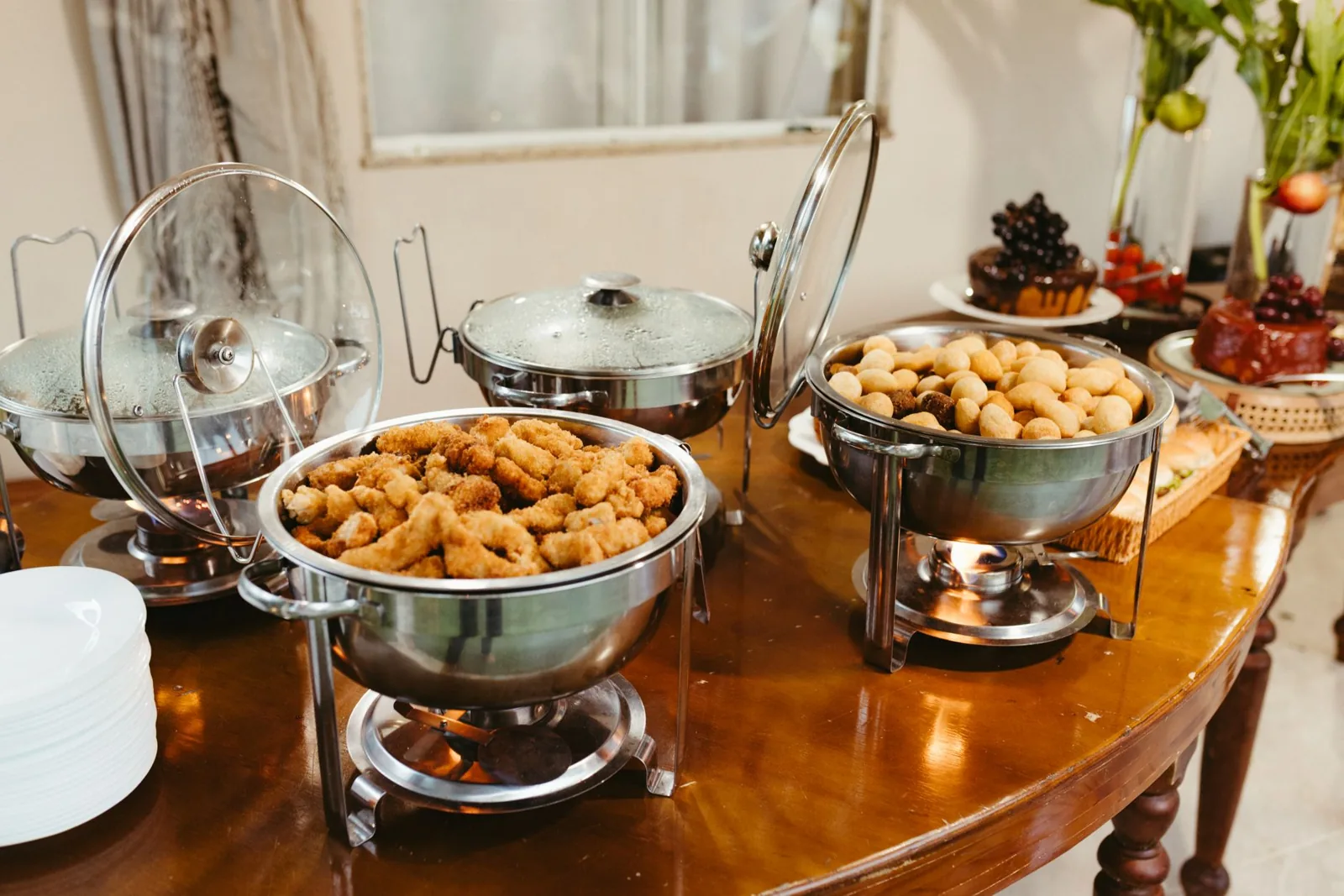
The open buffet is the default shape of hospitality in Saudi Arabia: wedding banquets, Ramadan iftar tables, hotel buffets, company events. Every one of them has a chicken dish at the centre of the table. The restaurant that delivers the food to that table has usually run the earlier stages well: the delivery was received and documented, held at temperature, cooked to the right internal reading. Then its management stops at the edge of the table, and the stage that produces most event-linked poisoning outbreaks begins: hours of exposed waiting in front of a hundred hands.
The display table is not a shelf — it is an operating stage#
The restaurant requirements issued by the Ministry of Municipal and Rural Affairs and Housing under a ministerial decision in 1446 AH define the danger zone explicitly: the temperature range between 5 °C and 60 °C, where bacteria multiply quickly, with an optimum for growth of roughly 37 °C. The document classifies meat and poultry as high-risk foods that require temperature control, and requires those products to stay at 60 °C or above, or at 5 °C or below.
The two numbers are simple. The difficulty is that the buffet table is the only place in the establishment where the food leaves the kitchen's control and passes under the guests' hands at the same time. That is why the requirements give display its own separate provisions rather than folding it into the kitchen rules — and anyone who reads those provisions once discovers that most of what a restaurant does at the table in good faith runs against them.
Six hours and four: what the requirements say about hot holding#
In its hot-holding section the document sets a dual time limit that many operators have never seen: hot food is held at not less than 60 °C and consumed within 6 hours, and if the temperature falls below 60 °C the food must be consumed within 4 hours or discarded. A drop below sixty does not condemn the dish on the spot, then — but it cuts its shelf life to two thirds and turns the clock from a routine into a countdown.
- Temperature limit: 60 °C or above for hot items, 5 °C or below for cold ones.
- Time limit while the temperature holds: 6 hours in hot holding.
- Time limit once it drops below 60 °C: 4 hours, then consumed or discarded.
- Equipment is checked regularly to confirm it is working effectively, and must reach the required temperature before any food goes into it.
- If no hot-holding equipment exists at all, food must be prepared for immediate consumption rather than for waiting.
A chafing dish is not a cooker and not a heater; it is a holder. Put lukewarm chicken in it and the food will sit a long time before it passes sixty, if it passes at all — and for that whole stretch it is inside the danger zone within a piece of equipment that looks like it is protecting it. The equipment is heated first, and the food goes in hot.
And only two hours outside the unit — for the cold dishes too#
The display provisions then move to the commonest case at a banquet: the dish that goes on the table with no holding unit under it. Here the ceiling drops sharply. Hot food is kept above 60 °C, and if it is displayed outside the hot-holding unit it must be consumed within two hours or discarded. The same provisions set the mirror rule for the cold end: chilled food, once it has left the refrigerator, must be consumed within two hours or discarded.
The mistake repeated at every banquet: a fresh batch on top of the old one#
The plainest sentence in the whole hot-holding section is this one: if food is taken out of hot-holding equipment to be displayed, it must not be mixed with food that is already on display. Which is precisely what nearly every restaurant does when it sees the chicken tray running low and tips the new pan from the kitchen on top of it.
The violation is not a formality, and it has two faults in it at once. The first is that the old batch's clock disappears: pieces that have spent three hours on the table become indistinguishable from pieces that arrived a minute ago, and no time limit means anything after that. The second is thermal: however hot the new batch is, the combined pan needs time to climb back above sixty, and after the pour the tray is a stack of layers at different temperatures — the coldest of them at the bottom, where the probe usually never goes.
The alternative the US FDA recommends in its own buffet guidance is simple and it works: replace nearly empty serving dishes with freshly filled ones, and keep buffet serving portions small. A small tray swapped every half hour beats a large tray that sits for three — thermally, visually, and in waste cost too.
- Prepare the dish in the kitchen in portions sized to the tray, not to the event.
- Preheat the replacement tray or unit before filling it, not after.
- Write on a small card the time each tray left the holding unit, and run the allowance from that time.
- When a tray runs low, lift it out whole and put the new one in its place — never pour one into the other.
- Treat whatever is left in the lifted tray as time-expired, not as stock to be returned to the table.
Protecting the food from the guest#
The second half of the display provisions has nothing to do with temperature; it is about contamination. Self-service means dozens of people pass over uncovered food, serving utensils travel between dishes, and nobody sees what happened between two rounds. So the requirements impose specific controls on any ready-to-eat food displayed uncovered:
- Protective barriers such as sneeze guards, to reduce the chance of contamination by customers.
- A separate serving utensil for each type of food, or another dispensing method that limits the chance of contamination.
- A responsible food handler supervising the display area, to remove immediately any food contaminated by a customer or likely to have been exposed.
- Ready-to-eat food not intended for self-service may not sit on an unattended table unless it is wrapped or packed in containers.
- Physical barriers separating uncooked food from ready-to-eat food in shared display units.
- Baskets lined with clean single-use liners, and wooden display units accepted only if treated so they are cleanable and food-safe.
Measure the food, not the air#
The temperature-control provisions require a monitoring system, and add two details that change how the table is run: recorded readings must represent the temperature of the food, not the air, in every part of the holding unit, and a probe thermometer must be used to verify the food itself rather than relying only on the gauges built into the equipment. The document also accepts a practical alternative: a thermometer placed inside the unit carrying a label reading for temperature checking only.
- Measure when the buffet opens: dish by dish, in the centre of a piece rather than in the sauce.
- Re-measure roughly every half hour, and log the reading with its time on a single sheet for the event.
- Measure the coldest point you expect: the edge of the tray nearest the draught, and the top of the pile.
- On any reading below 60 °C, move the dish onto the shorter countdown or lift it — and record the decision.
- Sanitise the probe between dishes, or the measuring instrument itself becomes a vehicle for contamination.
What is left after the last guest#
A dish that has sat on a self-service table with guests' hands passing over it is no longer raw material, and it does not go back to the kitchen to be served the next day however sound it looks. The allowance it was running under has expired, and nobody knows its contamination history. What can genuinely be saved is the portion that never left temperature control and never reached the table at all: the surplus still in the kitchen or still closed inside a holding unit.
That surplus has a defined route in the same requirements. Cooked food destined for the fridge is cooled so that the thermal centre of the product falls below 10 °C within two hours, after which it is held directly at 4 °C and used within two or three days of preparation. Reheating requires equipment that brings the food to an internal temperature of 75 °C, after which it is eaten immediately or placed into hot-holding — and re-chilling anything that has already been reheated is prohibited.
A checklist for the day before the event#
- Count trays, not just kilos of chicken: how many trays go out in each hour of the event.
- Confirm the hot-holding equipment covers every hot dish, and is switched on well before the food arrives.
- Prepare a separate serving utensil for each dish, plus a spare set, because utensils get dropped and swapped.
- Check that protective guards run the length of the table, not over some dishes and not others.
- Name the person responsible for the display area, and tell them it is their only job during the event.
- Have a calibrated probe, sanitising wipes for it, and one logging sheet for the whole event.
- Agree the buffet's closing time in advance, and run each tray's allowance from when it left the unit, not from when the event started.
- Settle with the host what happens to the surplus before the event begins, not after it ends.
The conclusion is that a buffet table needs what any production line needs: written limits, measurement, and a responsible person with a name. A restaurant that runs its table that way protects more than the guests at the event — it protects its own reputation, because a single outbreak at a banquet of three hundred costs more than everything saved by one re-displayed dish.
Frequently asked questions
Is a candle-heated chafing dish enough to hold 60 °C?
Usually not on its own. A candle or gel fuel only offsets slow heat loss; it will not lift food that has dropped below sixty, and it does not stand up to a draught in a large hall. The requirements do not prescribe a type of equipment — they prescribe the result: 60 °C or above, equipment brought up to temperature before the food goes in, and regular checks that it is working effectively. The only way to know the answer in your hall is to probe the food itself an hour into service.
How long can a tray of chicken stay on the buffet before it is pulled?
It depends what is under it. Inside hot-holding equipment running at 60 °C or above the limit is 6 hours, dropping to 4 hours once a reading falls below sixty. A tray displayed outside a holding unit has two hours and is then consumed or discarded, and that falls to one hour in hot conditions above 33 °C under the SFDA's guidance. The allowance runs from the moment that particular tray came out, which is why its out-time is written on a card beside it.
The tray is nearly empty — why can't I just top it up from the kitchen?
Because the requirements forbid it in so many words: food taken out of hot-holding equipment for display must not be mixed with food already on display. And the reason is practical before it is regulatory — mixing erases the old batch's clock, so no allowance means anything any more, and it creates layers at different temperatures in the pan with the coldest at the bottom. The alternative is to lift the old tray out whole and set a fresh one in its place, which is also what buffet guidance recommends, alongside keeping serving portions small.
Can I refrigerate what was left on yesterday's buffet and serve it today?
What has been on a self-service table is not re-served: guests, utensils and an uncertain amount of time have passed over it. The only surplus worth keeping is what stayed in the kitchen or in a holding unit and never reached the table, and it follows a defined route: rapid cooling to below 10 °C at the product's centre within two hours, then holding at 4 °C, and use within two or three days of preparation. On reheating, the requirements call for 75 °C at the core, followed by immediate service or hot-holding — and re-chilling it afterwards is prohibited.
Related articles

Chicken shawarma safety: what happens inside the cone while the outside looks perfectly cooked
11 min read
Holding cooked chicken hot until service: the temperature, the clock, and what happens to the crust in between
10 min read