Heat stress in broilers: how farms get chickens through summer
Heat stress is what happens to a chicken when its body can no longer get rid of its own heat. Birds have no sweat glands, feathers hold heat in, and a modern broiler grows so fast that its own body makes a lot of heat, which leaves panting as its main way out. In a Saudi summer where the national average daily maximum in July is 40.3 °C, farms rely on tunnel ventilation, cooling pads, cool water and moving feeding and transport to the night. The reassuring part for shoppers: no source says meat from a heat-stressed flock becomes unsafe. Heat can affect breast-meat quality and eggshells, though, and the biggest summer risk begins after you buy the chicken.
Why chickens suffer in the heat more than we do#
The University of Kentucky's poultry production manual puts the problem in two lines: birds do not have sweat glands, and feathers, great insulation in cold weather, get in the way of heat loss in hot weather. A grown chicken's body is also hotter than ours to begin with, between 41.1 and 41.7 °C — the 106 to 107 °F the university's poultry biology page gives. So when the air around it heats up, its one effective tool is panting: evaporating water from its throat by breathing fast with its beak open.
It is harder still for meat chickens specifically. A 2021 scientific review in Frontiers in Veterinary Science notes that the focus on high productivity has made commercial broilers more vulnerable to environmental stress, and that feather insulation is one of the main obstacles to their temperature control. A bird that grows fast makes more heat, carries more weight, and finds it harder to cool itself.
How a grower knows the birds are struggling#
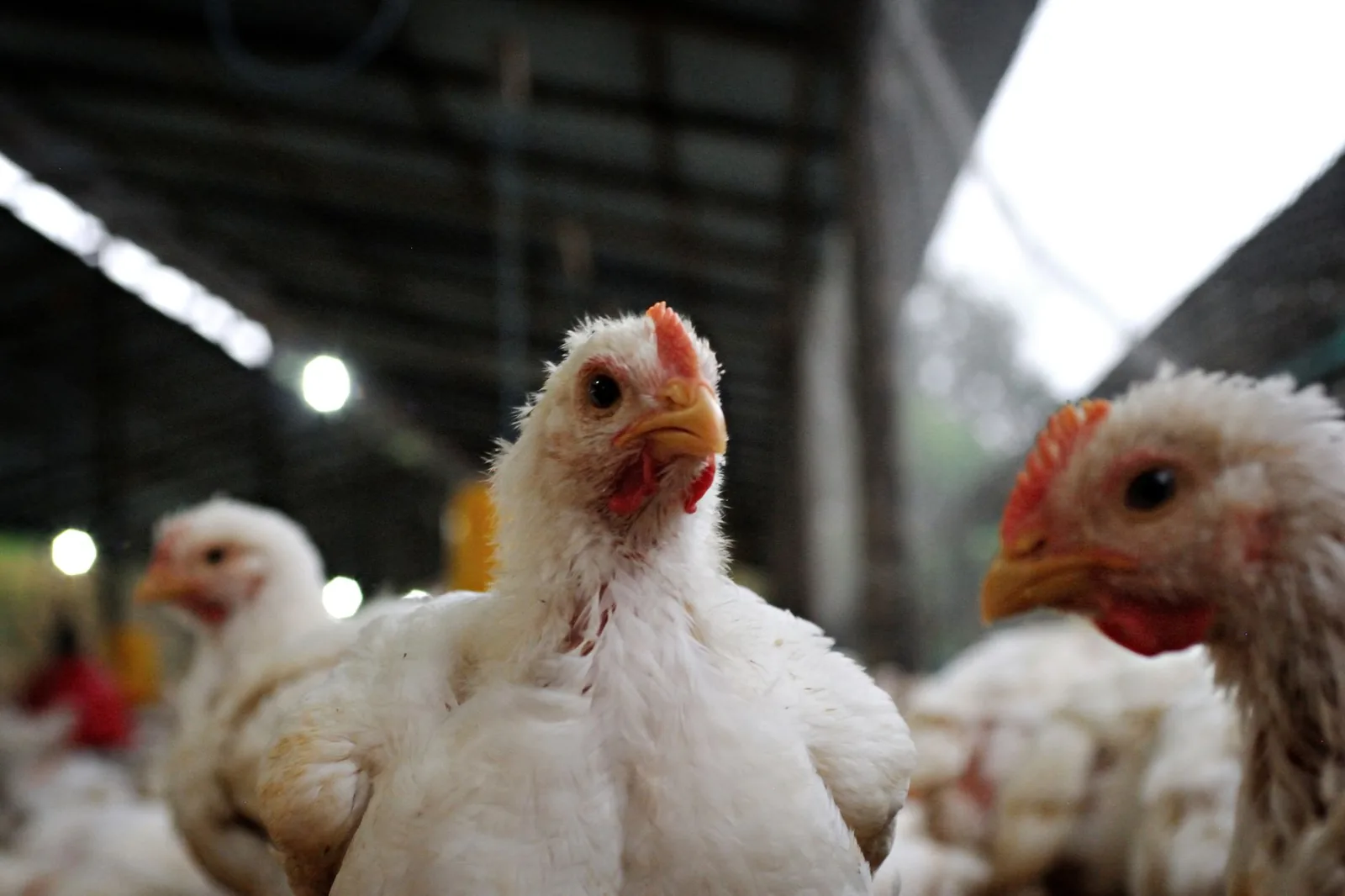
The signs of heat stress are visible to anyone who knows what to look for. The University of Florida extension service and the broiler management handbook from Aviagen, the company behind the Ross breed, describe them:
- Panting with the beak open, which normally starts when the air is near or above 30 °C.
- Wings held away from the body to cut insulation, or birds lying on one side with a wing open and a leg stretched out.
- Less movement: some birds stand quietly, others crouch near walls or drinkers.
- Aviagen's working rule: if more than 10% of the birds are panting, slightly or heavily, the flock is probably too warm.
Temperature is not the whole story: humidity#
According to the Ross handbook, panting becomes the bird's main way of losing heat at about 27 °C. Panting is evaporative cooling, and evaporation weakens as the air gets more humid. That is why the handbook explains that high humidity raises the temperature the bird actually feels at the same thermometer reading, and why the University of Florida warns that broilers cannot tolerate high temperature combined with high humidity: death from heat exhaustion comes very quickly, especially in heavier birds.
Hence the clear target of hot-weather ventilation: keep the house air below 35 °C, because air at that level can almost stop heat loss from the bird, as the University of Kentucky manual explains. Compare that with a Saudi summer. According to a National Center for Meteorology analysis reported by the Saudi Gazette, July is the Kingdom's hottest month, with an average temperature of 33.1 °C and an average daily maximum of 40.3 °C, and average maximums above 44 °C in parts of the Eastern Province and central Saudi Arabia. On a summer afternoon the outside air is hotter than the limit the house must stay under, so simply bringing it in is not enough.
How a modern house keeps its birds cool#
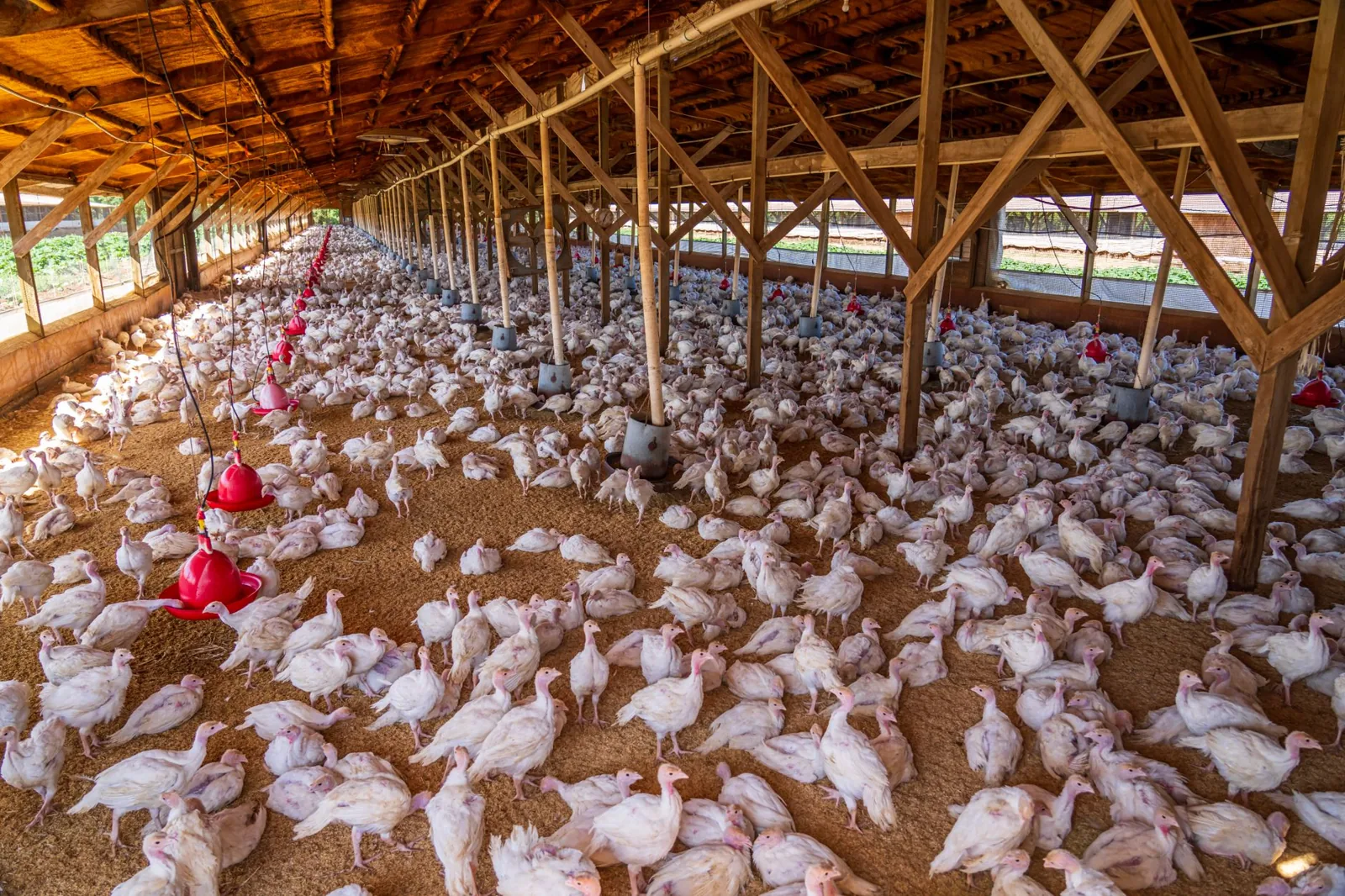
A farm does not rely on one trick but on a set of measures that work together. These are the main ones, according to the extension sources and the breeder's handbook:
- Tunnel ventilation: large fans at one end of the house pull air along its full length like a tunnel, cooling the birds by wind chill. The Ross handbook gives an example: at an air speed of 2.5 m/s, a 3.5 kg bird in 29.4 °C air feels roughly 23.8 °C, while the thermometer still reads 29.4 °C.
- Enough air speed: Mississippi State University Extension notes that many modern tunnel houses reach at least 600 to 700 ft/min, about 3 to 3.5 m/s, and that moving air is the primary way to cool broilers.
- Evaporative cooling pads and fogging: incoming air passes through wet pads and cools as the water evaporates. The Ross handbook stresses that high air speed matters much more than evaporative cooling, and that a pad cools the air by less than 2 °C once the outside humidity is above 80%; the drier the air, the more cooling it gives.
- Fewer birds in summer: Aviagen's hot-weather guidance says stocking density may need to be reduced during the hot season, so the flock produces less heat and air can move between the birds.
- Cool water, always available: according to the same guide, birds drink less once the water is warmer than 30 °C and refuse to drink at 44 °C and above, while their water needs rise about 6.5% for every degree above 21 °C.
- Moving feeding times: the University of Florida notes that fasting birds before and during the hottest part of the day lessens their heat load and improves survival, and the Ross handbook recommends letting them make up the feed at night.
- Salts and vitamins in water and feed: the Ross handbook says keeping the feed's electrolyte balance in the right range helps reduce heat-related deaths, and the Florida extension notes that vitamin C is often used as an anti-stress agent during hot spells.
Why do pads work well in Riyadh and less on the coast? Evaporative cooling depends on dry air. In the dry air of the central region water evaporates easily and cools the air more; in the summer humidity of Jeddah or the Eastern coast the pad does less, and air speed becomes the first line of defence.
From house to plant: transport in summer#
The risk does not stop at the house door. Aviagen's hot-weather guidance says that in hot periods birds should be caught at night, fewer birds should go into each crate, and trucks should wait under cover at the processing plant with fans running. The international standard for transporting animals by land in the World Organisation for Animal Health (WOAH) code goes further: in some extreme heat animals should not be moved at all, travelling at night may reduce heat stress, and stops should be kept short with vehicles parked in the shade and well ventilated. Locally, the Ministry of Environment, Water and Agriculture has urged animal owners to apply protection standards against high temperatures, as the Saudi Press Agency reported.
What heat does to growth, meat and eggs#
The first effect of heat is that birds eat less. The University of Florida notes that broilers kept in hot conditions cut their feed intake, and that the economic losses come from slower growth and poorer feed efficiency on top of the birds that die. A 2023 trial at King Saud University in Riyadh measured this: broilers kept at 34 °C for eight hours a day from day 25 to day 35 of age had clearly lower body weight, weight gain and feed intake. These are costs that end up in what a kilo costs.
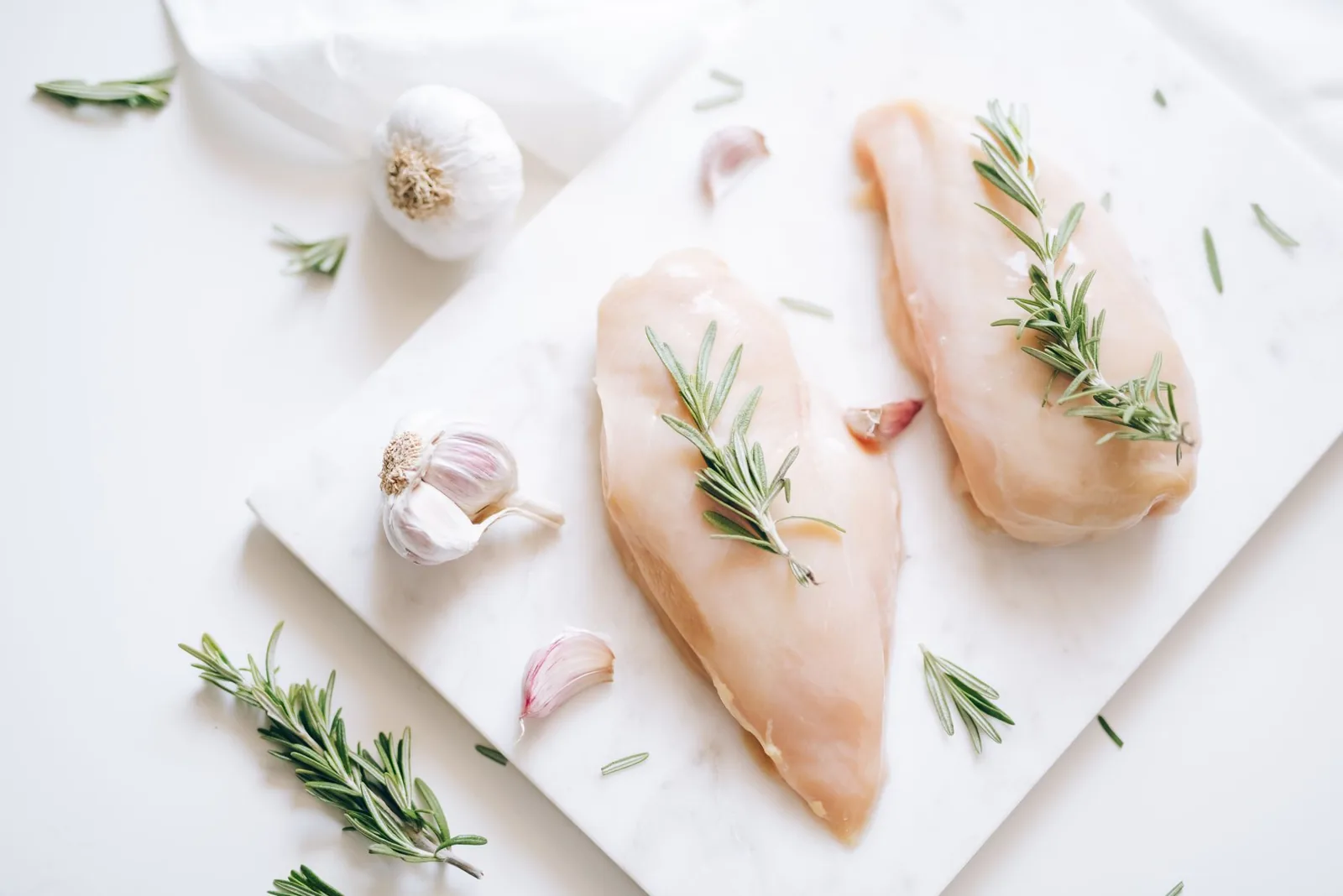
Meat quality is a subtler picture. The Frontiers review explains that heat can speed up the drop in muscle pH after slaughter, weakening its ability to hold water, which can end in what is known as pale, soft, exudative (PSE) meat, and that the industry reports hot-weather losses from pale colour and poor texture. Why that matters in the kitchen shows in a 2000 study in Poultry Science: pale breast meat took up less marinade than normal breast meat (31.2% vs 44.3%) and had a lower cooking yield (95.2% vs 105.8%), although that study did not test heat as the cause. The King Saud University trial, meanwhile, found no difference in breast-meat pH or cooking loss between heat-stressed and comfortable birds. So heat does not automatically spoil meat quality; it depends on how hard and how long the heat hits.
Eggs are affected too. In a 2004 study in Poultry Science, laying hens under heat stress produced fewer and lighter eggs, with thinner, lighter shells, and more hens died. That is a good reason to check shells a little more carefully when you buy eggs in summer.
Is summer chicken safe? And where the real risk is#
We found no scientific source saying that meat from a heat-stressed flock becomes unsafe to eat. A trial published in 2006 in Foodborne Pathogens and Disease found that heat stress did not raise the amount of Salmonella birds shed in their droppings or how long it survived, though the researchers noted that the heat in their trial may not have been intense enough to show an effect. The practical conclusion: in summer, chicken safety is decided by the cold chain and proper cooking, and that part is in the hands of the shop, the restaurant and you.
- Make chicken the last thing in your trolley, and carry it in a cool bag if the drive is long.
- Never leave chicken in a parked car, even for a few minutes, at midday.
- Put it in the fridge or freezer as soon as you get home.
- Cook it until the thickest part reaches 74 °C, and check with a food thermometer.
If summer chicken breasts look paler and softer and lose more water in the pan, that is a quality issue, not a safety one. In a restaurant, expect such breasts to take up less marinade and lose more juice, so avoid very high heat that dries them out, and track cooking yield in your records.
Frequently asked questions
What is heat stress in poultry?
It is a bird's inability to get rid of its body heat when the air around it gets hot. Chickens cannot sweat and their feathers hold heat in, so they rely on panting, which normally starts when the air nears 30 °C. When heat and high humidity come together, birds can die quickly, especially heavy ones.
Is chicken from a heat-stressed flock safe to eat?
We found no source saying it is unsafe, and one published trial found no increase in Salmonella shed by heat-stressed birds. The breast's colour, texture and water-holding can be affected, which is a quality matter. Safety is decided by the cold chain and cooking to 74 °C.
How do poultry farms cool their houses in summer?
Mainly with tunnel ventilation, which moves air at about 3 to 3.5 m/s so birds are cooled by wind chill, plus evaporative cooling pads, cool drinking water, fewer birds per house, feeding at night, and catching and transporting birds at night.
Does heat affect eggs?
Yes. In a published study, heat-stressed laying hens produced fewer, lighter eggs with thinner shells. So check shells carefully when you buy in summer, skip cracked eggs, and keep them in the fridge.