
Ready-roasted chicken: the two hours that start at the shop, not at home
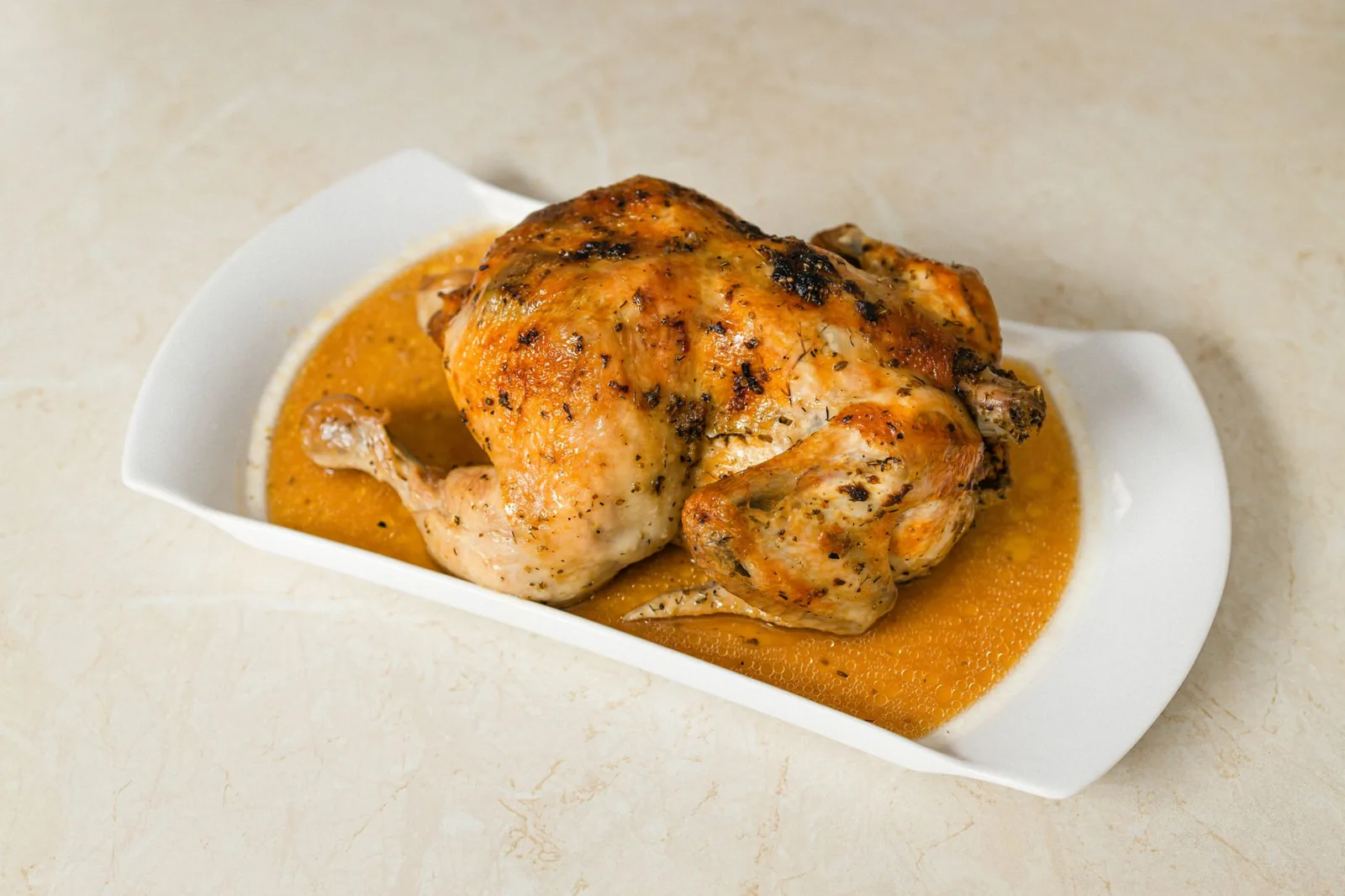
The ready-roasted chicken is one of the most-bought items in Saudi Arabia: a complete hot meal at a reasonable price that solves dinner in two minutes at the counter. At the moment it comes off the spit it is entirely safe, because it has just been cooked far past anything bacteria can survive. The problem is not the roasting; it is the hours that follow — the drive home, a quick errand on the way, and a bird waiting on the counter until the family gathers. This lesson is about exactly those hours, and about one decision taken at the front door that determines whether tomorrow's leftovers are sound or dangerous.
The clock starts at the shop, not at home#
The rule regulators use is simple and strict: perishable food is not left outside refrigeration or hot holding for more than two hours, and the limit drops to one hour when the ambient temperature is above roughly 32 °C. That is the USDA's wording, and it is what the Saudi Food and Drug Authority repeats in its own guidance. The common mistake is to start counting those two hours from the moment the bag lands on the kitchen table. The correct count starts when the bird left hot holding — at the till, not at the kitchen door. Queuing, sitting in the car park, stopping at the grocery: all of it comes out of the same two hours.
The car is the worst part of the journey, not a neutral waiting room. The US National Highway Traffic Safety Administration notes that a cabin heats by around 11 °C in ten minutes and can run some 28 °C above the outside air, and that cracking the windows or parking in the shade does not meaningfully change it. In a Riyadh summer that means the bird in your car is effectively under the one-hour rule, not the two-hour one. Make the roast chicken the last stop before home, not the first.
Hot means hot: "warm" is not a safe state#
The bacteria that cause food poisoning grow fastest in a band called the danger zone, running from about 4 °C to 60 °C. Cooked food therefore either stays hot at 60 °C or above, or is cooled quickly to 5 °C or below — there is no third option in between. The USDA puts it bluntly: merely keeping food warm is not safe. That is what makes the heated display cabinet in the shop part of the chicken's safety rather than part of its décor: it is equipment meant to hold 60 °C in the core of the product, not a lamp that casts a nice golden colour.
- Buy where the chicken is genuinely hot rather than lukewarm: steam inside the bag and real heat through the packaging are the first signals.
- Look at the display cabinet: is it heated and enclosed, or an open shelf under a lamp?
- Ask when the bird came off the spit if the shop is quiet and turnover looks slow. A busy shop is better, because the product does not sit.
- Prefer vented or slightly open packaging if you are eating immediately — a sealed bag traps steam and costs the skin its crispness.
- Take an insulated bag if the drive is long; it holds the heat instead of losing it slowly in the car.
- Do not buy a roast chicken you intend to eat hours later. Rotisserie is a meal for now, not a meal for later.
One decision at the door: eat it now, or chill it now#
When you walk in with a roast chicken you have two options and no third. Either it is served shortly and eaten hot, or it is chilled immediately. The option people actually take — leaving it on the counter to lose its heat, then putting it in the fridge at bedtime — is the worst of the three, because it walks the bird slowly through the entire danger zone instead of crossing it quickly. This is precisely where an organism like Clostridium perfringens thrives: its spores survive cooking and wait for exactly this kind of slow cool-down.
USDA guidance addresses ready-roasted chicken specifically: if you buy it hot and it will not be eaten within two hours, cut it into several pieces and refrigerate it in shallow, covered containers. Note that the advice is not to chill the bird as it is, but to cut it first. The reason is purely physical: a whole bird is a thick mass with an internal cavity, and its centre stays warm for hours even inside a cold fridge, whereas separated pieces in a shallow container shed their heat quickly.
- Strip the meat off the carcass while you are still inside the first two hours. The bird is hot and easy to break down, and this is the fastest moment to work.
- Spread the meat into shallow containers no more than about five centimetres deep — the depth the USDA recommends so heat escapes quickly.
- Cover the containers and do not stack them in the fridge; stacking insulates them and slows the chill.
- Put them into a fridge at 5 °C or below, the chilled-storage temperature set by the Saudi FDA, and a freezer at minus 18 °C.
- Do not wait for it to cool on the counter. Modern fridges handle warm food, and it is the waiting outside that is the hazard, not the opposite.
- Keep the carcass and bones in a separate container if you plan to make stock, and treat them by the same rules.
Three to four days, and one reheat#
Properly chilled cooked chicken is used within three to four days under USDA guidance, or frozen instead, where it keeps its quality for roughly three to four months. Freezing is a decision taken early, not late: meat that has already spent three days in the fridge does not become new again by entering the freezer, and freezing halts bacteria rather than undoing what has happened. The practical method is to split the bird on the day you buy it into meal-sized portions, keep in the fridge only what will be eaten within two days, and freeze the rest straight away.
For reheating the rule is explicit: 74 °C in the core of the food, once only — that is the Saudi FDA's stated warning. "Once only" means taking out a single portion that covers the meal in hand, rather than reheating the whole container, returning it cold and reheating it again the next day. And remember that reheating is not a remedy for an earlier mistake: some bacteria release toxins into the food itself, and those toxins are not destroyed by heat, so a bird that spent the night out of the fridge is not rescued by an oven or a microwave.
Small questions that keep coming up in the kitchen#
The crisp skin is the first thing lost to chilling and reheating; that is a question of quality rather than safety, and it has a simple answer: reheat in an oven or air fryer, hot and briefly, rather than in a microwave, which drives water out of the meat and softens the skin. Stock made from the carcass is treated exactly like any other cooked food: bring it to a boil, then cool it fast in a shallow container, and never leave it on the stove to cool by itself overnight. Any stuffing in the cavity always comes out and cools separately, because it is the slowest-cooling part of the bird.
A ready-roasted chicken is an excellent product when treated as what it is: a hot meal for right now, and excellent raw material for tomorrow's meals if it goes into the fridge, jointed, within two hours. The whole rule reduces to four numbers: 60 °C or above while hot, two hours out of refrigeration and one in the heat, 5 °C or below in the fridge, and 74 °C on a single reheat. None of the four needs special equipment — they need the count to start in the right place.
Frequently asked questions
I left a roast chicken in the car for two hours — can I just reheat it well and eat it?
No. Inside a car the temperature climbs quickly, so the allowance is one hour rather than two, and the bird has spent double that in the range where bacteria multiply fastest. More importantly, reheating does not solve it: some bacterial toxins form in the food itself and are not destroyed by heat, so you can kill the bacteria and still be left with what they produced. The regulators' advice in this situation is to discard the food — far cheaper than a day of illness.
Should I put the chicken in the fridge while it is still hot?
Yes, and that is the correct move. The old idea of waiting for food to cool on the counter is exactly what keeps it in the danger zone longest. Modern domestic fridges cope with warm food going in; the only condition is that it must not stall the cooling of everything else: joint the meat first, spread it in shallow containers about five centimetres deep, and leave space around them instead of stacking. The aim is to cross the gap between 60 °C and 5 °C as fast as possible.
How long do roast-chicken leftovers keep in the fridge, and when should I freeze them?
Three to four days in the fridge under USDA guidance, and roughly three to four months of good quality in the freezer. Freezing is a decision for the day of purchase, not the fourth day, because a freezer stops the clock rather than turning it back. The practical method is to split the meat into portions on the day you buy it, keep in the fridge what will be eaten within two days, and freeze the rest in flat, dated bags.
How can I tell the bird in the display cabinet is being held properly?
The first signal is that it is genuinely hot rather than warm, because the hot-holding requirement is 60 °C or above and anything below that is inside the danger zone. The second is a heated, enclosed display cabinet rather than an open shelf under a lighting lamp. The third is turnover: a busy shop sells its birds before they sit for long. If the chicken reaches your hand lukewarm, that is not a matter of taste but a sign that hot holding was not under control, and it is better not to buy it.
Related articles
Chicken in the air fryer: what the appliance actually does, and where the cook goes wrong
11 min read
Chicken in the school lunchbox: getting it to the break still cold and safe
11 min read