Chicken in the air fryer: what the appliance actually does, and where the cook goes wrong
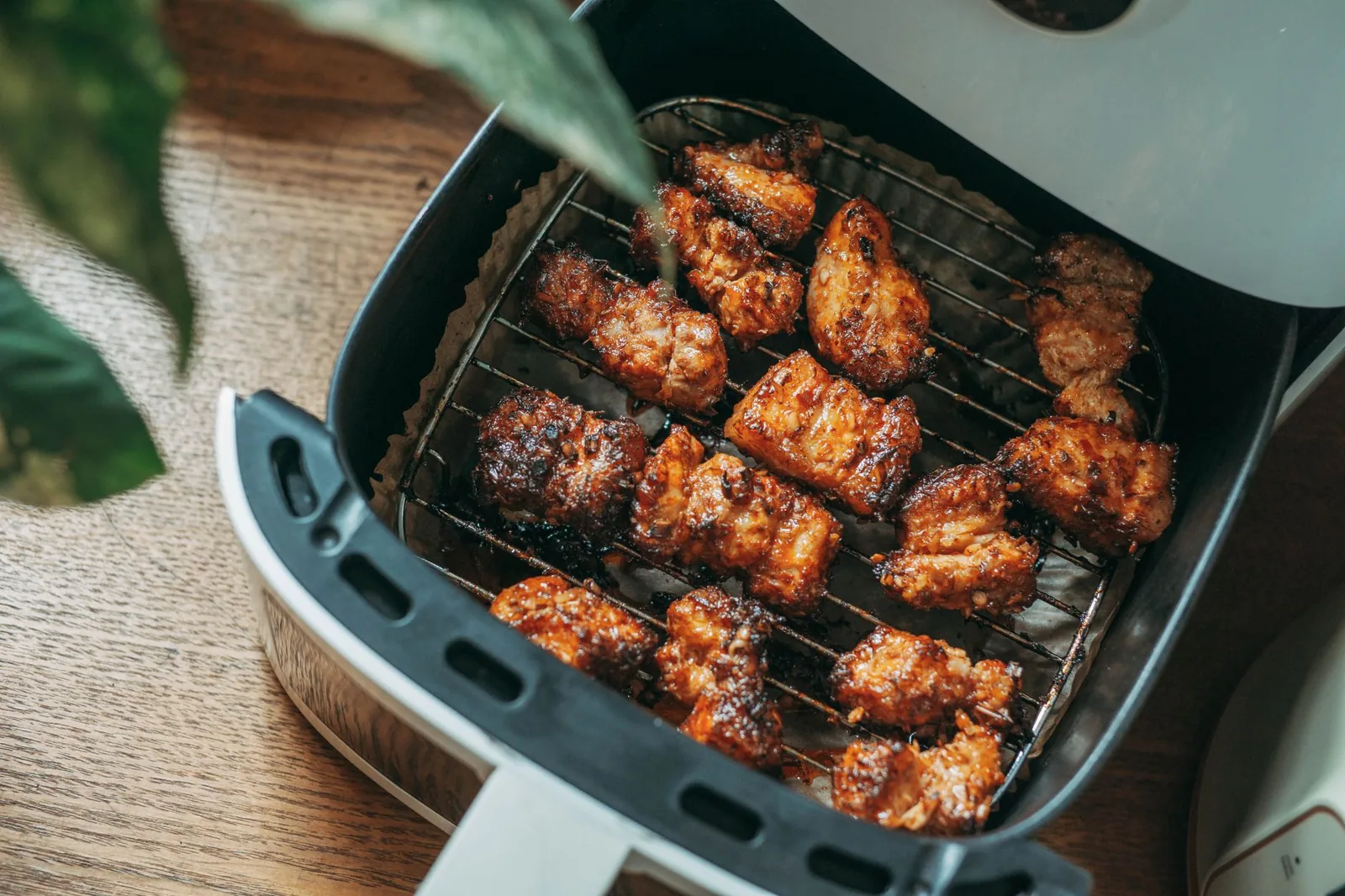
The air fryer arrived in most Saudi kitchens under a name that promises frying, and it does not fry. There is no oil surrounding the chicken and carrying heat into it from every side; there is a fan pushing hot air quickly around a small, closed chamber. That single technical difference explains the appliance's most common outcome: a piece of chicken with an excellent colour outside and a centre that never reached the temperature that kills bacteria. This lesson covers three things the appliance genuinely decides: how chicken cooks in it, why it can come out raw in the middle despite the colour, and the one product regulators explicitly say should not go into it.
An air fryer is a small convection oven, not a fryer#
The USDA describes an air fryer as a countertop convection oven: a heating element and a fan inside a sealed chamber, where the crispness comes from hot air circulating quickly around the food rather than from immersion in oil. The usual operating band is roughly 175 °C to 205 °C, and most items need somewhere between five and twenty-five minutes. The small chamber is both the advantage and the flaw: air reaches the surface fast and browns it early, but air is a far weaker carrier of heat into the depth of a piece than oil is, so the gap widens between what the eye sees and what is happening at the centre.
The name is the source of the confusion. In deep frying, a hot medium touches every surface of the piece at once; here, air merely passes over it. Colour is therefore no more a proof of doneness in this appliance than in any other — in fact it is rather less.
The number that does not change when the appliance changes#
Among its Salmonella-prevention advice, the Saudi Food and Drug Authority tells consumers to cook poultry and eggs to at least 75 °C, and the USDA sets 74 °C as the safe internal temperature for all poultry, including ground. The number is a property of the bacteria, not of the appliance: it is the same in an oven, on a grill and in an air fryer, and no device exempts you from it and no recipe online overrides it. The only way to verify it is a food thermometer, because meat colour and clear juices are unreliable indicators that food-safety authorities agree should be set aside.
- Put the probe into the thickest part of the piece — the centre of the breast or the inner thigh — without touching bone, which runs hotter than the meat around it.
- Read at least two different pieces, and pick the biggest and thickest rather than the smallest: a small piece finishes first and does not represent the rest of the basket.
- If the reading is below 75 °C, return the piece to the basket for three to four minutes and measure again in the same spot.
- Wipe the probe with an alcohol wipe between readings so it does not carry anything from a raw surface into a piece that is already done.
- Do not judge on the first reading alone when it sits right on the limit: rest the piece for two minutes and read again, since heat keeps travelling inward briefly after the basket comes out.
An overfilled basket is the commonest reason for a raw middle#
The warning the USDA repeats in its air-fryer guidance is simple and widely ignored: do not overfill the basket. The appliance depends entirely on air moving between the pieces, so when chicken is stacked in layers the path is blocked, cooking becomes uneven, and the result is food that is not cooked through. Its recommended fix is to cook in batches rather than all at once. This is exactly the point that disappoints someone who bought the appliance to save time: a four- or five-litre domestic basket will not feed a gathering, and forcing it to try turns a fast appliance into an unsafe one.
- A single layer with space between the pieces — not a pile and not stacked layers.
- Pieces of similar thickness and size in one batch: mixing a thick breast with small wings guarantees that one of them will be wrong.
- Turn the pieces halfway through, because the side against the basket receives less air.
- Two batches beat one crammed basket; hold the first batch above 60 °C, or chill it and reheat later to 75 °C.
- For a very thick piece, drop the temperature by about ten degrees and extend the time, rather than raising the heat to hurry it and scorching the surface.
The one product that does not belong in an air fryer#
There is one category regulators name outright: frozen raw breaded stuffed chicken products, such as cordon bleu and cheese-filled chicken fillets. The US Centers for Disease Control explains the danger in a single sentence: these products are partially cooked to set the breading, which often makes them appear cooked when they are not. Since 2006 producers have relabelled them to state clearly that they are raw, many warn against microwaves and provide validated cooking instructions for conventional ovens only — and outbreaks continued after those labelling changes. The USDA's own air-fryer guidance states that raw stuffed breaded chicken breast products should not be cooked in the air fryer.
A survey published by the CDC in its weekly report shows how wide the gap between instructions and behaviour is. It covered 4,142 adults between 31 May and 6 July 2022, of whom 2,546 had prepared these products. Some 82.7% used a conventional oven, while 29.7% used an air fryer, 29.0% a microwave and 13.7% a toaster oven. More telling still, only 38% said they typically used a thermometer to check doneness. In other words, close to a third of consumers cook these products in an appliance the manufacturer never validated instructions for — and most of them never measure the result.
The working rule: if the pack names an oven only, the oven is the only validated method, and the air fryer is not a faster version of it. Fully cooked frozen chicken products — nuggets labelled as fully cooked, for instance — are a reheating job rather than a cooking one; follow the pack and still verify the temperature.
Why the breast comes out dry, and how to fix it without touching safety#
Dryness is not a defect in the appliance; it is what overshooting the endpoint looks like, and it happens when the cook runs the process on a timer instead of an internal temperature. Fast dry air pulls moisture from the surface, so ten extra minutes added as insurance cost you the juices and bought nothing. The remedy is three simple things: even out the thickness by pounding a thick breast to a uniform height; choose cuts that forgive error — thigh and drumstick, whose fat and connective tissue give a wider margin than breast; and pull the piece at the number rather than at the end of the timer, then rest it for a few minutes before cutting. Marinating beforehand helps retain moisture, provided it happens in the fridge and not on the kitchen counter.
Acrylamide forms in the starchy coating, not in the meat#
Acrylamide comes up constantly in conversations about air fryers, and it is worth being precise about where it actually applies. The Saudi FDA explains that acrylamide forms in starchy foods cooked at high temperature — crisps, bread, toast, fried potato — that it has not been found in boiled foods, and it closes its consumer advice by saying you do not need to change your diet or the way you cook, but to eat a balanced, healthy diet. In a chicken kitchen that means a plain marinated fillet is not the question at all; the question is the breadcrumb or starch coating, and the potatoes served beside it.
As for the figure people repeat — that an air fryer cuts acrylamide by around 90% — it comes from Sansano and colleagues, published in 2015 in the Journal of Food Science, and it was measured on potatoes at 180 °C against deep-oil frying. The literature, though, is not settled: a 2024 commentary in Frontiers in Nutrition criticised the measurements in a later air-frying study because its values fell below its own limit of quantification, which makes the comparison unreliable. The honest position is that lower acrylamide in air-fried starches is plausible rather than proven — and that it is not, in any case, a health claim about chicken meat.
When the item carries a starchy coating, aim for golden rather than dark brown. Dropping the temperature slightly and extending the time gives the same crispness at a lighter colour — advice that applies equally to an air fryer and an oven.
After cooking: the basket, the drawer and what the juices leave behind#
Air fryers have a cross-contamination detail of their own: juices from raw chicken drip through the perforated basket into the drawer beneath it, and the drawer is the part people wash least, because in their mind it never touches food. Washing both with hot water and detergent after every raw-chicken cycle is not fussiness — nor is refusing to return cooked chicken to the plate that carried it raw, or to use a marinade that touched raw meat as a sauce unless it has been boiled first. Leftovers go into the fridge within two hours, and within one hour if the ambient temperature is above 32 °C, then get reheated to 75 °C. And the appliance is a cooker, not a holding cabinet: food left inside after it switches off drifts slowly down through the band of temperatures in which bacteria multiply.
An air fryer is a good appliance for chicken with reasonable crispness at a fraction of the oil, and on that count it beats a deep fryer in a home kitchen. What it does not do is change the rules: 75 °C at the centre, a basket that is not overfilled, a thermometer instead of a colour, and the pack's instructions where they are validated for one appliance in particular. Get those four right and the machine becomes what it was bought to be — a faster, lighter way to cook chicken that is safe.
Frequently asked questions
Can I cook chicken straight from frozen in an air fryer?
Plain raw chicken pieces can in principle be cooked from frozen, allowing roughly half as long again, but the small chamber and dry air usually produce a browned surface over a centre that has not thawed — so thawing in the fridge first is better, and never on the counter. For frozen raw breaded stuffed chicken products the answer is no in every case: their cooking instructions are validated for a conventional oven, and USDA guidance says not to cook them in an air fryer. Either way, the dish is only accepted on a reading of 75 °C at the thickest point.
Do I need to preheat the air fryer?
Preheating for three to five minutes gives a more even start and a better crust, and some manuals require it, in which case follow them. It is not a safety step and not a substitute for measuring: a preheated basket browns faster, which increases rather than reduces the need to check with a thermometer. Avoid putting baking or parchment paper into an empty basket while it preheats — the fast air can lift it towards the heating element.
Is an air fryer healthier than deep frying?
On fat, yes: the food is not immersed, so it absorbs no oil, and a spoonful does the job litres used to do — a real difference in calories. But healthiness is set by what goes in, not by the appliance: coated processed chicken pieces stay high in salt and fat whether they meet hot air or hot oil. The acrylamide advantage concerns starchy foods, is not scientifically settled, and does not apply to the chicken meat itself.
The chicken is browned outside and raw inside — what now?
This is the appliance's classic symptom, and it usually has three overlapping causes: an overfilled basket that blocks the airflow, thick or mismatched pieces in one batch, and a temperature high enough to brown the surface before the centre catches up. The fix is to lower the heat by ten to twenty degrees and extend the time, even out the thickness, keep a single layer with gaps, and turn the pieces halfway. If it does happen, the piece goes back into the basket until it reaches 75 °C — it is not served on the strength of its colour, and it is not rescued by reheating it on the serving plate.