Can you reheat leftover rice and chicken? The toxins that heat cannot undo
Yes, you can reheat leftover rice and chicken, but reheating is not what makes them safe; that was settled in the hours before. Some bacteria make toxins inside food that heat does not remove, and two matter most on our plates: Bacillus cereus in cooked rice, and Staphylococcus aureus in chicken handled after cooking. The US Food and Drug Administration (FDA) reports that the Bacillus cereus vomiting toxin stays stable after heating at 121 °C for 30 minutes, and the UK Food Standards Agency (FSA) says the problem is not the reheating but how the rice was stored before it. The working rule: chill leftovers within an hour if you can, eat the rice within a day, and reheat it only once, until it is steaming hot all the way through.
Does reheating kill bacteria and toxins? Two answers, not one#
The previous lesson in this course ended on the point that enough heat kills Salmonella, Campylobacter and Listeria, but that does not cover everything that causes food poisoning. Hong Kong's Centre for Food Safety puts it plainly: the toxins formed while Bacillus cereus and Staphylococcus aureus multiply cannot be eliminated by reheating. On a plate of rice and chicken, three organisms meet, and reheating plays out differently against each:
- A ready-made toxin in the food: Staphylococcus aureus in chicken that was handled and then left warm produces a heat-resistant toxin, and Bacillus cereus does the same in rice. Heat kills the bacteria; what they made stays.
- Spores that outlast cooking: Bacillus cereus in rice and Clostridium perfringens in big pots both form spores, dormant forms with a protective coat, which survive boiling and wake up as the pot cools slowly.
- A toxin made in the gut: perfringens illness starts after large numbers of its live cells are eaten, so thorough reheating does help here, because it kills those cells before they reach the gut. Against the two ready-made toxins in the first point, it achieves nothing.
Why rice in particular: Bacillus cereus and cereulide#
The UK Food Standards Agency says uncooked rice can contain spores of Bacillus cereus, and that those spores can survive cooking. In Saudi Arabia, a study from Princess Nourah bint Abdulrahman University published in Food Science and Technology in 2022 found the bacterium in 20 of 40 samples of uncooked rice bought at retail. None was detected straight after cooking, but after 12 hours at 25 °C the spores had germinated and grown. A pot that comes off the heat clean may not stay that way if it sits on the stove until evening.
The FDA notes that outbreaks of the vomiting type have generally been linked to rice products, and that the bacterium grows between 4 °C and 48 °C, fastest at 28 to 35 °C; the Saudi study points out that room temperature can reach 37 °C in hot countries. As it multiplies in the grains it produces a toxin called cereulide, which the FDA describes as resistant to heat, acid and digestive enzymes and stable after heating at 121 °C for 30 minutes. The agency states the consequence itself: cooking may kill the bacteria, but it might not disable the toxin that causes the vomiting.
A documented case from outside the Kingdom shows the whole mechanism. The US Centers for Disease Control and Prevention (CDC) documented 14 people falling ill at two child day-care centres in Virginia in 1993 after chicken fried rice made from rice cooked the night before, cooled at room temperature before refrigeration, then pan-fried that morning. The median time to symptoms was two hours, and CDC noted that the heat-stable toxin formed at room temperature can survive brief heating such as stir-frying. This is the pattern popularly called 'fried rice syndrome'.
If cereulide rang a bell from the 2026 news, it is the same toxin: in a 2026 assessment the European Food Safety Authority (EFSA) described it as a heat-stable emetic toxin, after it was detected in infant formula from several manufacturers. That story has nothing to do with rice, but it rests on the same property.
Chicken that has been through many hands: Staphylococcus aureus#
The second hazard comes not from the rice but from people. CDC says about 1 in 4 people carry Staph on their skin and in their nose, and the FDA says food handlers are frequently the source in staphylococcal outbreaks, the usual vehicles being foods that need a lot of handling and are then kept slightly above proper refrigeration temperature for a long time, chicken salads and sandwich fillings among them.
On a Saudi table that means chicken pulled apart by hand and spread over the rice, platters arranged piece by piece, and chicken sandwiches made up hours ahead for a trip or an event. Cooking kills the bacterium, but here the cooking came before the handling, so if the chicken then stays warm the bacteria multiply and release their toxin. According to the FDA, killing the cells with heat does not destroy enterotoxins already formed, because they are highly heat stable; S. aureus grows from 7 °C to 47.8 °C, and its toxin reaches illness-causing levels once the population passes 100,000 organisms per gram.
The FDA's own example comes from Texas, where 1,364 of 5,824 schoolchildren fell ill from chicken salad: the chicken was boiled and deboned the day before, cooled in front of a fan, stored overnight in a walk-in refrigerator in 12-inch-deep pans, then left at room temperature until served. A review of US outbreaks from 1998 to 2008 by CDC researchers, published in Clinical Infectious Diseases in 2013, found contamination by a food worker in 55% of S. aureus outbreaks, while it was uncommon in Bacillus cereus and Clostridium perfringens outbreaks. Closer to home, a 2004 review by a Ministry of Health author in the Saudi Medical Journal, citing an earlier study, attributed 41% of 781 foodborne-disease events reported to the Ministry between 1411 and 1413 AH to S. aureus. The figures are old, but they show the organism has been in local records for decades.
If you are going to pull chicken apart by hand to spread over rice or fill bread, do it just before serving, with washed hands, and do not leave shredded chicken warm on the table waiting for guests. Anything shaped by hand needs the shortest possible gap between touching and eating.
The big pot: Clostridium perfringens, briefly#
The third organism, Clostridium perfringens, is the one the cooling and reheating lesson already covers, including how its spores survive cooking. This lesson adds two things. The first is speed: the FDA says its active cells can double in under 10 minutes, so it reaches dangerous levels during slow cool-down faster than other bacteria, and it names large quantities of food prepared several hours before serving as the most common setting, a fair description of a banquet pot. The second is that it does not make its toxin on the plate: the FDA classes its illness as a food infection, with the toxin produced in the gut. That is why thorough reheating helps against this one, although the real protection is still cooling the pot quickly in the first place.
The kabsa platter after lunch: when the clock starts#
The same Saudi study calls rice the main meal at every gathering, from Eid to weddings and dinner parties, names kabsa, Bukhari rice, biryani and mandi among its dishes, and warns that large amounts are often left over and may sit at room temperature for a long time before being refrigerated or passed on to charities. A separate study by SFDA researchers, published in 2025, looked at suspected food-poisoning incidents in Riyadh and found rice to be the food vehicle in 38 cases, behind poultry (93) and meat products (45), without attributing those cases to any single organism. Cases peaked in June.
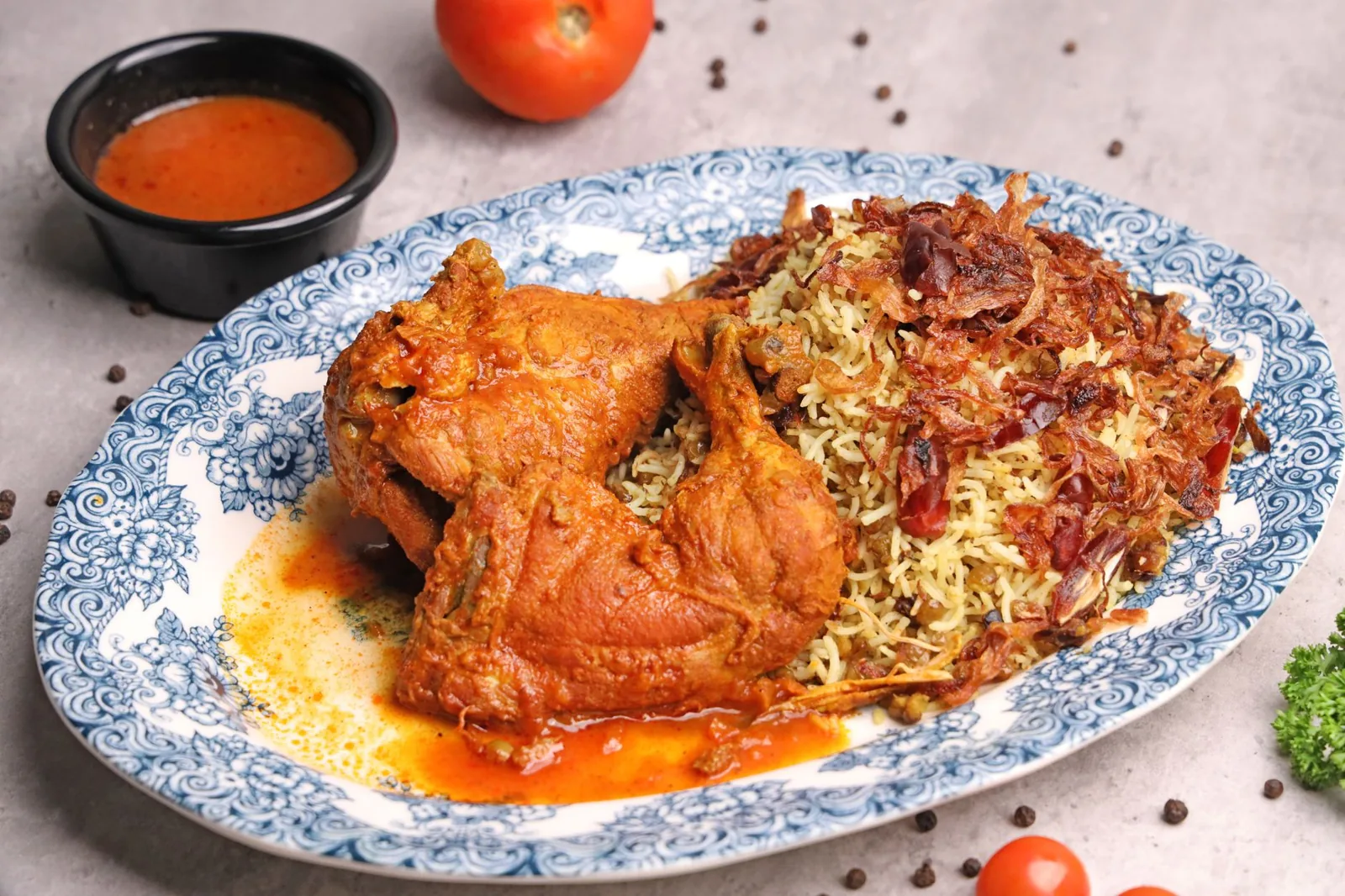
Picture an ordinary family gathering. The kabsa pot comes off the heat after the noon prayer, the chicken is laid on the platters by hand, the guests eat, and the platters stay on the sufra until after the coffee, while half the pot waits on the stove, lid on, for dinner. Every critical hour in that scene comes before any reheating: the grains cool slowly in a covered pot through the range where Bacillus cereus grows, the hand-arranged chicken stays warm, and the big pot of broth and meat takes a long time to cool, as USDA's Food Safety and Inspection Service warns of any large pot. By the time dinner is brought back to a boil, whatever was going to happen has already happened.
The SFDA treats food left at room temperature for more than two hours, or more than one hour above 32 °C, as food to be thrown away; for rice, the FSA asks for leftovers to be chilled ideally within one hour. These limits are not just theory. A study by a King Faisal University researcher, published in the Journal of Family and Community Medicine in 2007, documented an outbreak of diarrhoeal illness in a tent of 50 soldiers in Mina during Hajj, 16 of whom fell ill, in which rice was the only food significantly linked to illness. The rice and meat were served in the same dish and left in a tent without air conditioning for between 1 and 4 hours, 2.8 on average, then eaten without reheating. The author judged Bacillus cereus, Clostridium perfringens or both the most likely cause, without laboratory confirmation.
At a wedding in Sulayyil, reported in the same journal in 2010, first-sitting leftovers were put out again with the second dinner at 2 am; 93% of the guests who ate them fell ill, against 19.5% of those who did not. The organism was Salmonella, not a toxin, but the lesson carries over: a second sitting needs food prepared for it, not food that waited for it on the sufra.
The clock does not start when the last guest leaves the sufra; it starts when the pot leaves the heat. From that moment the food is either being eaten or on its way into the fridge.
Gathering leftovers, step by step#
These are the steps for leftover rice and chicken on which the official sources agree; the full cooling method and reheating temperatures are in the cooling and reheating lesson:
- Get the rice out of the pot as soon as serving is done. The FSA says rice should not be left to cool in the pot, steamer or rice cooker, and the SFDA advises splitting large quantities across several containers before storing.
- Store the rice and the chicken in separate containers. They keep for different lengths of time, as the next section explains, and a mixed platter forces you to hold the chicken to the shorter limit that applies to rice.
- Do not wait for it to cool on the counter. The SFDA allows hot food to go straight into the fridge, and the FSA wants rice chilled ideally within one hour.
- Eat the rice within a day, or freeze it. The FSA says cooked rice should stay in the fridge no more than one day before reheating, and that getting it into the freezer within an hour of cooking stops bacteria from multiplying and producing toxin.
- Reheat it once, until it steams all the way through. That is the FSA's wording, and the SFDA likewise limits reheating to a single time.
Rice in the fridge: why one day, not four#
You will find different numbers for how long leftovers keep, and the difference is real. USDA's Food Safety and Inspection Service gives leftovers in general 3 to 4 days in the fridge, the FSA gives them 48 hours and then drops to one day for rice on its own, and the SFDA's awareness page on leftovers sets no number of days. The shorter figure belongs to rice, and the reason is the organism that comes with it.
The FDA gives 4 °C as the minimum growth temperature for Bacillus cereus, close to the 0 to 5 °C the FSA wants in a fridge, so cold slows this bacterium without granting an open-ended allowance. More important, the fridge cannot repair what happened before it: cereulide stays stable for 60 days at 4 °C, according to the FDA, so rice that spent the afternoon on the stove takes its toxin into the fridge with it. The World Health Organization's Five Keys to Safer Food put it in one line: do not store food too long, even in the refrigerator.
The practical rule for a mixed rice-and-chicken platter: treat it as rice, which means one day in the fridge. If you want the chicken to last longer, separate it from the start, and freeze whatever will not be eaten tomorrow.
Cases no amount of reheating will rescue#
In the situations below the answer is the bin, however hard you boil it, because what you are worried about may be a ready-made toxin rather than live bacteria:
- A pot of rice left on the stove or in the rice cooker from lunch until night, or overnight, even with the lid on.
- A kabsa or mandi platter left on the sufra past the SFDA's time limit, and all the more so in an outdoor majlis or a tent in summer.
- Chicken shredded or arranged by hand and then left warm for hours, whether on the rice or in sandwiches.
- Rice that has already been reheated once; the FSA says rice should never be reheated more than once.
- Cooked rice that has been in the fridge for more than a day.
- Leftover restaurant or delivery rice of unknown history that sat out of the fridge: the FSA warns that some businesses pre-cook rice and reheat it before serving, so your reheat may be the second.
The rule in one sentence: reheating decides how hot the meal is, not how safe it is; safety was settled in the hours the food spent between the stove and the fridge.
Vomiting within hours or diarrhoea next day: reading the symptoms#
Because the toxins of Bacillus cereus and Staphylococcus aureus are eaten ready-made, they act fast, whereas Clostridium perfringens needs time to multiply in the gut. According to the FDA:
- Bacillus cereus, vomiting type: begins 0.5 to 6 hours after eating, and is the form linked to rice.
- Bacillus cereus, diarrhoeal type: begins 6 to 15 hours after eating; symptoms of both types usually subside within 24 hours.
- Staphylococcus aureus: onset is usually rapid, within 1 to 7 hours, and the illness usually lasts from a few hours to one day.
- Clostridium perfringens: symptoms appear about 16 hours after eating, and the milder form generally lasts 12 to 24 hours.
These windows help you understand what happened; they do not diagnose it, since symptoms overlap and sources give slightly different ranges. CDC adds that antibiotics are not used for staph food poisoning, because they do not affect the toxin. The signs that call for a doctor are in the Salmonella, Campylobacter and Listeria lesson, and the full onset table, with what a restaurant must do when a family reports falling ill after eating there, is in the food-poisoning complaint lesson.
Frequently asked questions
Is leftover rice bad for you, and can it actually poison you?
Not by nature, but it can if it was stored badly. The UK Food Standards Agency says uncooked rice can carry Bacillus cereus spores that survive cooking, and that the longer cooked rice is left at room temperature, the more likely the bacteria or their toxins will make it unsafe. Rice that was cooled quickly, refrigerated and eaten within a day is within what the FSA advises; rice that spent hours on the stove is not something reheating can put right.
Can you reheat rice twice, and what about restaurant or delivery rice?
No, not twice. The UK Food Standards Agency says rice should never be reheated more than once and should be steaming hot all the way through when it is, and the SFDA likewise limits reheating food to a single time. The FSA also asks for extra care with takeaway rice, because some food businesses pre-cook their rice and reheat it before serving, so reheating it at home could be the second time. The safest approach is to eat delivered rice when it arrives and to order an amount that fits the meal.
Is it safe to eat cold leftover rice as part of a diet?
Yes, with conditions. The UK Food Standards Agency says rice may be eaten cold if it was cooled down quickly, kept in the fridge and eaten within 24 hours. The condition that matters is how it was cooled, not how cold it is now: rice left to cool in the pot for hours and then refrigerated may carry cereulide, which the FDA says stays stable for 60 days at 4 °C. This lesson does not cover nutrition, but no claimed benefit is worth rice that was stored the wrong way.
Several guests vomited a few hours after a banquet. Was it the rice or the chicken?
It could be either, and timing alone will not settle it. The FDA says the vomiting type of Bacillus cereus illness, generally tied to rice, begins 0.5 to 6 hours after eating, and that staphylococcal poisoning, tied to food handled after cooking such as shredded chicken, usually begins within 1 to 7 hours. What the two share is that the toxin was already in the food before anyone ate it, so the failure lay in the hours the dish spent warm, not in how well it was cooked. CDC notes that staph food poisoning symptoms usually last 24 hours or less.