
Minced chicken: what changes once the meat is ground
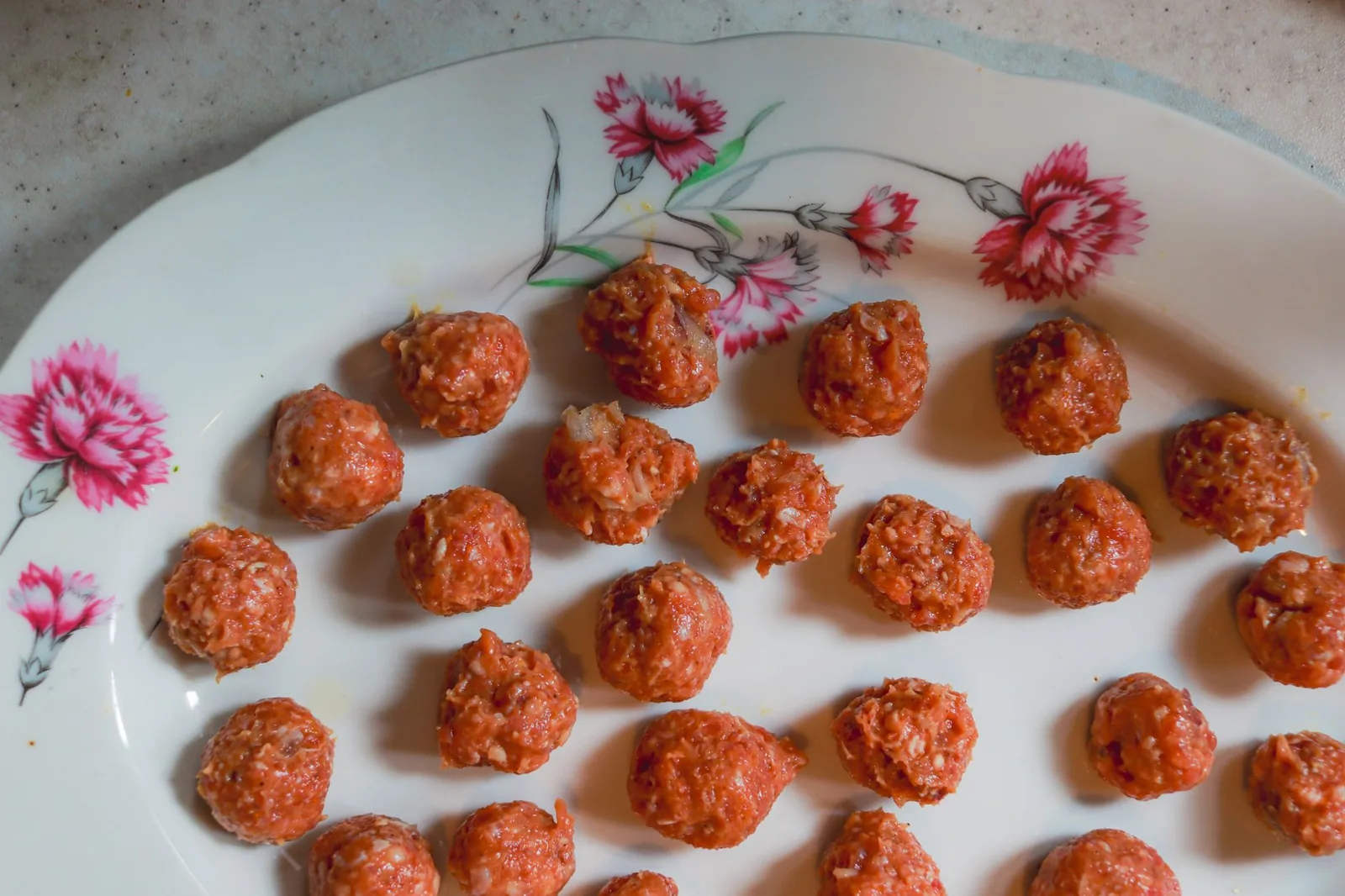
Minced chicken differs from whole chicken pieces in one essential way: mincing carries the bacteria that sit on the surface of the meat right through all of it, so no part of it is protected. That is why it gets the same rules with no slack at all: one to two days in a fridge at 4 °C or below, a shorter freezer life at −18 °C than whole cuts, and cooking until the centre of the thickest piece reaches 74 °C — read on a food thermometer, not judged by colour. Those are the figures of the US Food and Drug Administration and the US Department of Agriculture, and in Saudi Arabia the municipal health requirements for meat and poultry shops put strict conditions on whoever minces and sells it.
Why mince is a different food from a chicken breast#
In an intact breast or thigh the bacteria are concentrated on the outer surface, which is the first thing the heat of the pan or oven reaches. Mincing chops the meat into small particles and mixes them, so whatever was on the outside ends up in every mouthful, and the surface exposed to air, hands and tools multiplies. One contaminated piece going into the grinder is enough to spread across the whole batch. It is the same logic that lets a beef steak be served pink while a beef burger should not be — and chicken is never served undercooked either way.
The numbers bear this out. A study published in Frontiers in Microbiology in 2018 tested 199 ground-poultry samples bought from retail stores in Tulsa, Oklahoma, and found Salmonella in 41% of them: 46% of the ground-turkey samples, and 26% of a smaller set of 49 ground-chicken samples. In 2021 the US Centers for Disease Control and Prevention recorded a Salmonella outbreak linked to ground turkey that made 33 people ill across 14 states, 4 of them in hospital, and its advice to consumers was to check the temperature with a food thermometer. The message is not that mince is dangerous; it is that the margin for error is narrower.
What the Saudi regulation requires of the shop#
The health requirements for shops that prepare and sell meat, poultry and their products, issued by the Ministry of Municipal and Rural Affairs in 1440 AH (2019), devote Article 17 to minced meat and poultry. Under Article 12, which covers red meat, preparing or displaying mince in advance is strictly forbidden: meat is minced in front of the customer only. Poultry has its own articles, and minced poultry, by contrast, may be handled only by shops licensed for it, and Article 17 requires those shops to observe the following:
- The preparation area must not exceed 10 °C while the mince is being made.
- The mince must come from a single kind of meat, so chicken is not mixed with anything else.
- It must contain no bone, cartilage, tendon, offal or any part not normally eaten.
- Colourings, preservatives, starch, plant fibre and non-animal proteins are banned, except in products declared to contain added soy protein.
- Frozen chicken is minced at −4 °C; chicken that has fully thawed may not be used for mince and may not be refrozen.
- Frozen poultry used for mince must not be past half of its shelf life.
- The mince is stored chilled between 0 °C and −1 °C, or frozen at −18 °C or below.
Most of these conditions are invisible to the buyer, but some translate into things you can check for yourself: that a ready pack is cold and states the kind of meat, the ingredients and the dates, and that any added soy protein is shown. Mincing in front of the customer is the rule for red meat; for chicken it is good practice worth asking for, not a right the regulation spells out.
How to buy minced chicken#
- Ideally, choose the piece yourself — skinless breast or thigh — and ask for it to be minced in front of you in a clean grinder.
- On a ready pack, read the production date, the expiry date, the storage temperature and the ingredients list, and pick the latest date.
- The pack should be intact and sealed, with no leaking liquid or bloating, and cold to the touch.
- Breast mince is light pink and thigh mince a little darker; reject anything grey or greenish, sour-smelling or slimy.
- Make the mince the last item in your basket, bag it apart from vegetables and bread, and go straight home.
In a Saudi summer the familiar two-hour rule does not apply: the US Department of Agriculture cuts the maximum time perishable food may spend out of refrigeration to one hour once the temperature is above 32 °C, and a parked car is far hotter than that. Take a cool bag if the drive is long.
In the fridge and the freezer#
The US Department of Agriculture advises keeping raw poultry and ground meats in the fridge for one to two days only, and the US Food and Drug Administration's storage chart puts ground meats, ground turkey included, at one to two days in a fridge at 4 °C — the same as whole chickens and pieces — and three to four months in a freezer at −18 °C, against nine months for chicken pieces and a year for a whole bird. The same chart notes that continuous freezing keeps food safe indefinitely, and that those months are for quality, not safety: after that the mince dries out and loses flavour. If you will not cook it within two days, freeze it on the day you buy it, not on the third.
- Keep it on the bottom shelf of the fridge, in a container or on a plate, so its juices cannot drip onto ready-to-eat food.
- Before freezing, divide it into freezer bags of one meal each, and flatten each into a thin, even layer.
- Press the air out of the bag and write the date and quantity on it.
- A flat bag freezes faster and thaws faster, and you can snap off a portion without thawing the rest.
Thawing, and whether you can refreeze#
The safest way to thaw mince is in the fridge, where a flat bag thaws in about a day. If you are in a hurry, put the sealed bag in cold water and change the water every 30 minutes, as the US Department of Agriculture advises, or thaw it in the microwave and cook it immediately afterwards. Do not thaw it on the counter: its outer layer sits at room temperature for hours before the centre has thawed.
On refreezing, the US Department of Agriculture separates two cases: mince thawed in the fridge may be refrozen without cooking, at some cost to quality, while mince thawed in cold water or the microwave should be cooked first and then frozen cooked. Note that the Saudi regulation is stricter on the shop: chicken that has fully thawed may not be minced or refrozen. If you see mince in a shop that looks as if it has been frozen twice — a layer of ice inside the pack, or frozen liquid around it — leave it.
Cooking: the number that replaces the colour#
The US Department of Agriculture's guidance is that ground poultry is safe once it reaches 74 °C (165 °F), measured with a food thermometer through the whole piece, regardless of its colour. The warning about colour cuts both ways: the same department explains that poultry can stay pink after reaching a safe temperature, and its research on fresh ground-beef patties, presented in 1998, found that more than 25% turned brown inside before reaching a safe temperature. A kofta can look done when it is not, and look pink when it is safe.
- For burger patties and kofta, push the thermometer probe in from the side to the centre, and measure the thickest piece, not the thinnest.
- On kofta skewers, check more than one skewer, because heat is not spread evenly across a grill.
- In sauces and stews made with mince, let them boil and stir until the lumps break up and no raw pink is left.
- For sambosa, stuffed vine leaves and stuffed vegetables, cook the mince filling fully before stuffing: frying time for sambosa pastry is too short to cook a raw filling through.
- Minced chicken is never served medium, even where the same restaurant serves its beef burger that way.
In the kitchen, your hands are the biggest risk#
No food in the kitchen is handled as much as mince: seasoning, kneading, rolling into balls, pressing into patties and fingers. All of it means that what is in the meat moves to your fingers, then to the fridge handle, the spice jar and your phone. Wash your hands with soap and water for 20 seconds before and after, as the US Centers for Disease Control and Prevention advise, set out spices and tools before you touch the meat, and use a board and bowl kept for raw food. Do not rinse mince under the tap: water does not remove bacteria, it splashes them over the sink and everything around it.
Never taste raw kofta or burger mix to check the salt. Fry a teaspoon of it in the pan for a minute or two until fully cooked, taste that, and then adjust the seasoning.
Cooked mince and what is left over#
Once the dish is cooked, the arithmetic changes: the US Food and Drug Administration's chart gives cooked poultry dishes three to four days in the fridge and four to six months in the freezer for quality. The condition is that it goes into the fridge within two hours of cooking — one hour in hot weather — divided into small, shallow containers so it cools quickly. When reheating, bring it to 74 °C, or to the boil if it has a sauce. Because cooked mince cools and reheats quickly, it is one of the best things to batch-cook for the working week, provided the raw mince is cooked on its first or second day.
From the shop to the pan: the whole routine#
- Buy the mince at the end of your shopping trip, or have a piece you chose minced in front of you.
- Get it into the fridge within an hour in summer, in a cool bag if the drive is long.
- Decide on the day you buy it: cook it within two days, or freeze it at once in flat, dated bags.
- Thaw it in the fridge, in cold water changed every 30 minutes, or in the microwave and then cook it at once.
- Wash your hands before and after shaping it, and never taste the mix raw.
- Cook it to 74 °C at the centre of the thickest piece, and do not rely on colour.
- Refrigerate the leftovers within two hours, and eat them within three to four days.
Frequently asked questions
How long does minced chicken keep in the fridge?
Raw, one to two days only at 4 °C or below, according to the US Department of Agriculture and the US Food and Drug Administration's storage chart — the same limit as whole chicken pieces, but mince leaves no room to stretch it, because what was on its surface is now inside it. Cooked, three to four days. If you will not cook it within two days, freeze it on the day you buy it.
Why is my chicken kofta still pink when the thermometer reads 74 °C?
The US Department of Agriculture explains that poultry can stay pink after reaching a safe temperature, for chemical reasons in the meat pigment that have nothing to do with doneness. If the thermometer reads 74 °C at the centre of the thickest piece, it is safe. The reverse matters more: brown colour alone does not prove it is cooked.
Can I refreeze minced chicken after thawing it?
If it thawed in the fridge and stayed there, you may refreeze it raw within its storage time, at some cost to texture and flavour. If it thawed in cold water or the microwave, cook it first and then freeze it cooked. A shop is held to a stricter rule: the Saudi regulation forbids it to mince fully thawed chicken or to refreeze it.
Is it better to mince chicken at home?
Mincing at home gives you control over the cut, the fat content and when it was minced, provided the chicken is fridge-cold and you take the grinder or food processor apart afterwards and wash every part in hot, soapy water, because meat left in the blades is an ideal place for bacteria to grow. Home-minced chicken is cooked within one to two days, exactly like bought mince.


